Stellate ganglion blocks for Long COVID

Serving Albany, Saratoga county and beyond

Even though they have recovered from the acute effects of COVID-19, some continue to suffer a wide range of symptoms. Some estimates that 77 to 23 million patients – a staggering number-  continue to suffer years after infection. Collectively these symptoms are called “long COVID”.

Studies have shown successful outcomes following a stellate ganglion block (SBG). 

A new target for Stellate ganglion blocks - Long COVID

There is emerging evidence that stellate ganglion blocks are useful for more than PTSD! Since the pandemic, many lost their ability to smell or suffer anosmia or suffer Long Covid.  A recent study suggests Stellate blocks are effective in restoring smell and treating brain fog.  If you suffer from Long Covid, consider this treatment option.

What Is Long COVID?

Ketamine is a schedule III medication that is FDA approved for anesthesia. While ketamine is considered investigational by the FDA for the treatment of mood disorders, many large scale trials have been performed. There is general agreement that low dose ketamine is a powerful and unique.

Symptoms of Long COVID

Individuals with long COVID may have symptoms severity from mild to debilitating:

  • Anxiety
  • Blood clots
  • Brain fog
  • Changes or lack of taste
  • Depression
  • Fatigue
  • Feeling faint due to a drop in blood pressure
  • Fevers
  • Gastrointestinal problems
  • Increased resting heart rate

Long-Haul COVID Recovery

A study in Nautre 2022 of 127 recovered COVID-19 patients 52 percent still had symptoms at an average of 29 days since the virus started. Of the patients who had mild COVID-19 symptoms, 29.5 percent had ongoing symptoms. This study reported that 15 percent had problems with smell. Another 14.2 percent reported taste issues, and 14.2 percent had an ongoing cough. Potential signs of psychological distress were seen in 30.7 percent of the patients. Among the whole study group, 29.1 percent showed possible work performance impairment.

COVID-19 and PTSD

The pandemic affected every segment of our society and caused a large increase in the number of people experiencing PTSD. A 2023 study of 329 participants who survived hospitalization after contracting the virus found that 26.7% developed PTSD symptoms. A report that the Centers for Disease Control and Prevention (CDC) commissioned states that over half of public health workers experienced symptoms of a mental health condition during the COVID-19 pandemic. Independent of the stress and isolation experienced by so many some patients have symptoms attributed COVID-19 years later.

Stellate Ganglion Block for Long Covid

We know an SGB increases blood flow to the brain. To explain the improvement seen in patients with Long COVID after a SGB, it's theorized that this helps resolve autonomic nervous system malfunction and resolves a destructive feedback loop.

Stopping this process may lower the patient’s risk for long COVID-related diseases like diabetes, hypertension, depression and obesity.

Stellate Ganglion blocks treat Anosmia and Parosmia

Preparing yourself for a Stellate Ganglion Block: Before and Aftercare Guide

Stellate Ganglion Blocks for Long Covid


How is a Stellate Ganglion Blocks Performed?

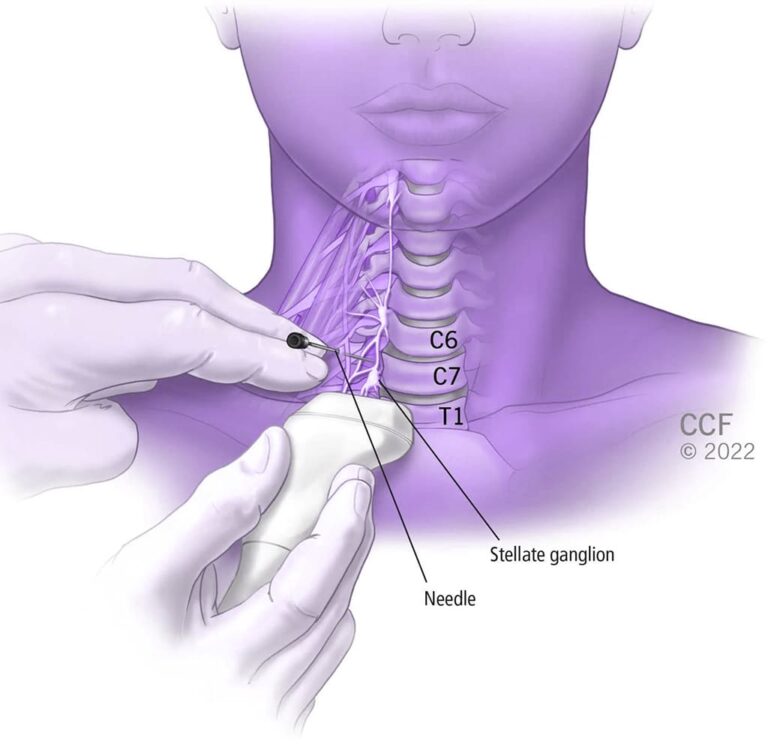
The injection is near the base of the neck and near the front. It typically takes less than 10 minutes to complete.

You’re positioned on it. And after the skin is cleaned and numbed with local anesthetic, the needle is placed gently and guided under ultrasound imaging. The ultrasound shows the needle and stellate ganglion, and makes the procedure safer!

Post-traumatic stress disorder symptoms typically improve within minutes of completing the procedure.

If you continue to suffer symptoms of Long COVID
consider Stellate Ganglion Blocks

After learning about long COVID, do you think you’re experiencing this? If so, speak to your doctor and ask about treatment with a stellate ganglion block. We offer cutting-edge treatments, including stellate ganglion blocks, to help manage long COVID symptoms. Schedule an appointment today and start feeling better!

Are there Side effects or Risks of the procedure?

Yes, and it's our job to explain them thoroughly! Fortunately with ultrasound guidance, the risks are minimal. The major risk is if the local anesthetic may cause a seizure. This can be avoided by seeing the blood vessels and using minimal volume. This is rare occuring less than 1 in 10,000 procedures. There are 2 common side effects: The Stellate ganglion is connected to blood vessels in the face, nose, and muscles in the eye. Once local anesthetic is injected into the Stellate Ganglion there are some changes that occur called a Horner's syndrome. There is facial flushing, nose stuffiness, and eyelid drooping. This proves the injection was performed correctly. These side effects are temporary. The second side effect is a cough, also temporary.

Is this covered by insurance?

No. The use of stellate ganglion block for Long COVID is still considered to be an “off-label” and will not be reimbursed by any insurance carriers. However, the therapy does fall under the umbrella of a medical expense and we can accept payment from an HSA or FSA account. Independent of the stress and isolation experienced by so many some patients have symptoms attributed COVID-19 years later.

OK, I'm interested, what else should I know?

Most insurances do not cover ketamine therapy in an OUTPATIENT SETTING. We’ve considered this and can administer Ketamine therapy in different ways than IV infusions. The cost is based on complexity.

Intranasal  – $ 200 for each session

Subcutaneous – $ 300 for each session

Intramuscular- $ 300 for each session

Subcutaneous infusion – $ 400 for each session

Intravenous infusion- $ 450 for each session

Payment is due 4 days prior. 

The difference is how much actual ketamine gets into your body.  We call this bioavailability.

Intranasal – 30-50% bioavailable, peak effect at 15 minutes

Subcutaneous – challenging to measure, probably slightly less than intramuscular, peak effect is 15 minutes

Intramuscular – 93% bioavailable, peak effect 15 minutes

Intravenous- 100%, peak effect is 1 minute

The biggest difference between these forms of administration is the ease of dose adjustment. Ketamine is a powerful medication. Ideally, it should be slowly given, and just as easily stopped as needed.

Intranasal The last invasive and gentle exposure to Ketamine therapy 

Intramuscular – Is a single shot. Once given, can’t be taken back.

Subcutaneous – Can be a single shot or given as a continuous infusion. The dose cannot be as changed as easily as IV.

Intravenous – Most flexible in terms of dose.

Depends on the condition.

For Mood disorders – 6 sessions, usually 2 a week. Each visit lasts about 90 minutes.

For Pain – 6 sessions, usually 2 a week. Each visit last about 2-4 hours. Really depends on the patient.

Your probably aware Ketamine infusions for mood or pain performed in a outpatient center aren’t covered by most insurance carriers. We can use your insurance only for the initial and any subsequent consultations.

The charge for the initial consult is $225.00. Follow up consults after a procedure are $150. 00

We offer discounted services to frontline workers and providers including teachers, civil service workers, and veterans. Advance Care is a service that offer’s financing options for medical care and can help you pay for treatment; learn more by calling 800-432-9470 or visiting advancecarecard.com. Click the Care Program to learn more.

Individuals with a history of substance abuse, uncontrolled high blood pressure, certain heart conditions, or severe psychiatric disorders like schizophrenia may not be good candidates for ketamine therapy. It’s important to consult a healthcare provider to assess suitability based on individual health conditions.

Individuals with a history of substance abuse, uncontrolled high blood pressure, certain heart conditions, or severe psychiatric disorders like schizophrenia may not be good candidates for ketamine therapy. It’s important to consult a healthcare provider to assess suitability based on individual health conditions.

Individuals with a history of substance abuse, uncontrolled high blood pressure, certain heart conditions, or severe psychiatric disorders like schizophrenia may not be good candidates for ketamine therapy. It’s important to consult a healthcare provider to assess suitability based on individual health conditions.

ADDITIONAL RESOURCES FOR PTSD TREATMENT, ANXIETY AND LONG COVID

Stalling Ganglion Block Relieves Long COVID-19 Symptoms in 86% of Patients: A Retrospective Cohort Study

Treatment Education and Updates